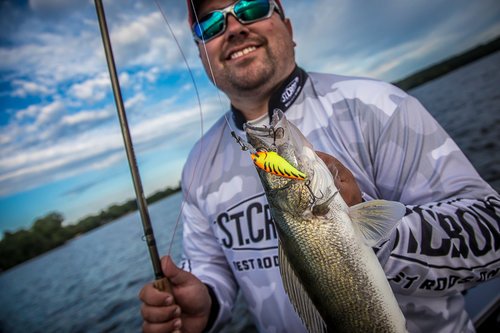
Getting Started With Leadcore

Photo Credit - Matt Addington

Photo Credit - Matt Addington

Getting off the ground with a new system can be challenging.  You’ve got the initial capital expense just in equipment, and a steep learning curve ahead regarding the use of it.  When it comes to running leadcore line for walleyes however, both the cost and effort to get better at it are justified expenses.  With leadcore trolling being a technique a great lakes charter captain would more likely deploy than a land-locked lakes angler, there’s a bit of an intimidation factor.  That’s probably why I field more questions on leadcore than any other subject during the summer months.  Rest assured, though it may seem tricky at first, it very quickly becomes old hat and something you wished you’d have tried sooner. 

As walleyes move progressively deeper throughout the summer months, having a strong leadcore game in your arsenal can be one of the best ways to continue getting bit well into the August doldrums.  No matter what part of the water column your ‘eyes are in, the idea behind leadcore is that a length of lead weight running through the center sleeve of a braided line can help sink any offering pulled behind it down and into the fish’s zone. 

More than just a search tool, it can be an effective way to target fish spread out along a long break or large structural element.  When pulling live-bait rigs and even spinners takes too long between pods of fish, and a healthy dose of concentration is needed in big-water, leadcore allows you to put rods in holders and ride out swells while putting fish in the boat at the same time. 

Leadcore is far from a big-water-only pattern either, as Mille Lacs guide and walleye-guru Brad Hawthorne will tell you, it works on smaller lakes just the same.  He recently took 4th place at the Camp Confidence Tournament on Gull Lake, a water-body he’s only fished a handful of times in the fall, by pulling his Mille Lacs-ready leadcore setups out of his rod storage and slapping them into holders.  “We smacked a 23 (inch walleye) right away, then another mid-20’s fish, and continued to put ‘eyes in the boat on a long stretch of break that people were lining up on to live-bait rig.” 

Personally, I’ve pulled walleyes out of lakes far smaller than Gull using leadcore, even at night for clear water bodies.  The point is that it flat-works, but how to get started?  You may have heard that it can be finicky, knot easily, while having the tendency to run together and tangle all the baits in your spread.  While there is some truth to that statement, the benefits far outweigh any negatives, and getting off the ground with this technique will prove it to you.     

The Setup – The cornerstone of every good leadcore program is a Medium to Medium Heavy, Moderate Action trolling rod, paired with a slightly oversized line-counter reel, and a spool of leadcore line.  You can easily spend well over $200 per combo, but you don’t need to, especially if you’re unsure how much leadcore trolling you’ll be doing.  Buy two combos at a time, so you can spool up the same way, with the same amount of line, on the same rod/reel.  Learning one system will make it less confusing. 

The Line - Big boxes and small tackle shops alike make it easy these days by helping you both with the purchase, and by spooling up for you.  Start with a reputable #18lb leadcore line, and for those looking to up their game, consider the Sufix Advanced leadcore.  Standard leadcore dives on average 5-feet per color, with the Advanced leadcore diving to 7-feet per color.  The result is more depth per less units of line, but either way, consider putting on a full-core.  Leadcore line is marked by a different color every 10 yards, so a full-core would be 10-colors, or 100 yards.  You will likely not need to dive to this depth, but it’s a good starting place to get you acquainted with the method.  Start by filling the reel first with some backing, which can be braid or mono, though mono is cheaper.  The amount is variable, so it’s often best to fill one reel backwards starting with leadcore, then backing until full, then fill the empty reel from the full one noting on your linecounter how much backing was used.  Fill the original, and now empty reel with the same amount of backing, then secure the leadcore for two full reels that are the same.

The Leader – On the end of your leadcore goes a leader of varying length and material.  On Lake Pepin, or other areas where I’m trolling hard substrate with zebra mussels, I run a 3-5 foot section of braided leader, then a snap, then my lure.  On ultra-clear water bodies like Mille Lacs, I run a 30 foot leader of 10# Fluorocarbon to keep my offering less visible.  Unsheath the end of your leadcore, and pull out 6 inches or so of the lead.  Pull the sheath back down and use it to tie an applicable braid to mono, or braid to braid knot.

The Lures – Any crankbait runs well with this scenario, as do spinners and a variety of other lures designed to be pulled. 

Putting It Into Action – Start by letting out a few colors of line while going 2.2-3.0mph.  Let out line evenly to prevent overruns and do your best to keep kinks and tangles to a minimum.  When leadcore knots, the interior lead can break and poke out in places.  These fractures make everything more difficult, so avoid them by dropping line back slowly and evenly.  Deep diving crankbaits should be let out until you’re reliably making contact with bottom occasionally.  You don’t want to be digging in constantly, as this causes baits to wander then tangle.  Pull along gradually similar depths, and as you get better at both reeling in line and letting it out to trace bottom, work your way towards pulling it along breaks. 

When employed in this manner, leadcore is a great tactic for getting crankbaits near bottom.  Through experience, you can learn to do this well, and cover the bulk of advantageous leadcore trolling situations.  That said, there’s even more we can do with leadcore to cover all kinds of bases.  Stay tuned, as advanced leadcore tactics will be the subject of next week’s article.

Side-Imaging for the Walleye Crowd

Photo Credit - Matt Addington - http://mattaddingtonphotography.com

Photo Credit - Matt Addington - http://mattaddingtonphotography.com

Walleye-anglers are a traditional bunch in-general.  New techniques and technologies are directly compared to known commodities, and rightly so.  There’s no use making things more difficult than they need to be, yet sometimes along the way what’s learned is in and of itself valuable.  I find that to be especially true in the case of side-imaging electronics for walleye fishing. 

So often, structural anglers are used to locating a spot of interest via high definition contours, then picking those locations apart with traditional down-sonar in an effort to locate fish, catch them, and store location (GPS) information in order to return to that spot someday down the road.  Lest we forget, at one time this technology was also new, though its adoption was rapid amongst the ranks of professionals and casual anglers alike.  Still, I’ve heard it mentioned in even upper echelons of walleye nerdery, that Side-Imaging is only for “bass-guys.”

A staple amongst tournament bass anglers these days is Side-Imaging runs that map both structural elements, and individual fish to target.  At last year’s Bassmaster Angler-of-the-Year tournament on Mille Lacs, dozens of complete strangers to the fishery pulled 60lb. bags of smallmouth bass during the 3-day competition, most of them leaning heavily on using their Side-Imaging to locate large boulders and individual bass off them.  This very application while being a classic use of the technology, is not a reason to classify it as a “bass-only” benefit.  

Shallow water walleyes can be found throughout the warm-water months during big wind events, even in clear water.  That same clarity provides a solid reason to consider Side-Imaging on your next electronics purchase, as walleyes rarely tolerate overhead boat traffic in clear-water shallows.  The imaging becomes your eyes up shallow, allowing you to stay back off of the fish, and put a multitude of presentations to them without pushing them around and killing the bite.  Shallow fish are typically feeding, so these are the fish you’re looking to target anyway.

While Side-Imaging proves very valuable for any species relating to shallow structural elements, the same also holds over the depths.  It’s a common misconception that side-imaging isn’t useful at the same depths we’re typically targeting walleyes.  On a recent trip to Grand Rapids, MN, I used my Lowrance Carbon-12 to image an underwater point I’ve fished often, both during open-water and through the ice.  While I knew there was an 8-foot rock-pile along the shallow lip of it, I didn’t give credit to that rockpile and how it affected walleye movements out and away from it.  All of our bites came off the pile some distance in 14-18FOW, as fish staged there before dark awaiting the low-light evening assault on those shallow rocks.  Not surprisingly, immediately out from the pile was a hard-bottom, rock-free shelf.  It was noticeably different from the surrounding break, and drew the majority of those fish.  Once I knew what I was looking for, I could find it on the down-sonar, but it literally jumped out at me on the side-imaging.

An even deeper application can be found on the famed mud flats of Mille Lacs, where savy anglers for many years have known that not all parts of all flats are mud.  There is a surprising amount of rock and gravel in certain locations, though most are in small out of the way places along the edge of the flats.  With a good chop, and the resultant screen display of your sonar showing a “wavy” bottom, it’s difficult to detect the tell-tale signs of rough or un-even rock bottom.  These locations, being different from surrounding substrate for at times, miles, almost always have fish on them or nearby.       

Perhaps the best way to introduce yourself to the technology is to image an area you already know, preferably if you know it holds fish.  So often as walleye anglers we stumble onto a mere piece of the puzzle.  We catch fish on one side of a reef for a short period of time in late afternoon, without realizing that we only intercepted fish in a 30 minute window making their way out of the depths and up to structure to feed.  Even if we know fish are likely to be up top and actively eating, we know not what locations have the largest boulders, the most pronounced feeding shelves, or what areas are too weed-choked to effectively fish in low-light.  All of those answers can be gleaned from a quick pass or two around the structure of interest. 

Take this technology for a spin on a few locations you’ve fished for years, and be amazed at the depth and level of information it offers you.  Consider it the best real-time map that’s offered today, and get used to seeing and interpreting what information in the plan direction really means to your fishing, rather than just the profile depth direction we’re so used to seeing in the sonar of old.   

The Next St(age)

After a fairly successful introduction to fishing for my two young sons, now ages 9 and 12, it’s been a slow-go in recent years.  It took some steady learning on my part to understand that snacks, bait, shoreline rocks, and frogs were far more interesting an experience, and that all the pressure I put on myself to keep bobbers dunked and lines tight didn’t really matter all that much unless they had the freedom to experience fishing the way they wanted to.  About the time it started clicking for me, it came to a grinding halt for them.  What was once an easy task to convince them to head out fishing for a few hours, became painstakingly difficult, requiring bribes and negotiations regarding all kinds of competing activities.  Maybe I’d made it too easy for them, or perhaps there was still too much focus on the fishing?  Either way I had somehow managed to do what I promised not to do, which was burn them out on it in some way or another.

Now, as my boys have gotten past those initial stages, I see them coming back to the sport of fishing that I know and love, just maybe not as much for the same reasons.  All of which is fine by me, as anything that gets them on the water is positive as far as I’m concerned.  A few fishing fanatic friends have really turned the tide, as angling becomes a way to hang out with their buddies as much as anything.  It’s amazing how “uncool” something can seem when coming from your parents, only to find out how “cool” it is when introduced to the very same activities and ideas by peers.  A bit of boyhood bravado, brought on by some impressive fish pictures, has helped to fuel that fire as they trade these photos back and forth as if they were a form of currency or man-measure.  All of which is not necessarily that dissimilar from our own grown-up angling aspirations.

I certainly don’t know it all as it pertains to helping your kids along with fishing, but my own family has provided a great case-in-study.  I continue to learn the do’s and don’ts of fishing with kids, and am anxious to see where it goes from here.  That said, here’s what I’ve learned in helping to take some initial interest and grow it into what I hope becomes a life-long activity for them:

Bigger Species – Kids eventually bore from the bluegills and crappies under a bobber routine, and at least for my own kids, by ages 7 and older they were ready to try some other species.  While they didn’t then, and still don’t, have the patience for an all-day walleye expedition, pike and bass provide more than enough excitement to keep them busy.  Going after the “big” fish becomes a great draw, even when not catching as their attention-span gradually increases.

New Techniques -   My children hated trolling or more passive techniques like live-bait rigging, even when catching fish.  Then, casting was the draw, and forcing them to keep the rod in a holder or worse, in-hand but still, was pure torture.  Now, simple patterns like throwing spinnerbaits to weed edges or casting senko-type plastics in the shallows will keep the kids busy for hours, especially if the action is reasonable.  As their fishing universe expands, you’re creating a feedback loop where the more they learn and understand, the more they want to consume.

Bring a Buddy – Take advantage of the fact that as your kids get older, they often naturally want to spend more time with friends than just family.  Recently, on a Lake Pepin trolling run, I had my oldest in the boat for more than half a day, and his buddy posted his (at the time) personal best walleye.  We were trolling crankbaits, something my son previously couldn’t stand.  Now I’m fielding requests from other friends of his that want some boat time, and the benefit is getting to spend some more time with your child and fishing all at the same time. 

Photos and More – With how digitally easy it is to preserve and send memories these days, take as many photos as you can.  You’d be amazed at how proud they are of fish or experiences you wouldn’t think to take shots of, like the recent 10lb Sheepshead my son caught while hoping it was a walleye the whole way to the net.  If you’re socially savvy, share their catch and watch their chest swell as others congratulate them and pile on accolades.  Those memories mean more to them than we know. 

Don’t Forget the Fun – Even though their patience level is increased and they may be able to make it all day, make sure the event stays fun.  For them, every trip on the water is special, no matter how often you get a chance to fish, so make sure to do all those little things right.  Maybe it’s a meal out on the way home, some special boat snacks, or even just letting them pick the music (as painful as that may be) in the boat or on the drive to and from.

It’s a fun ride, and I continue to learn more with each trip I take, but know that there’s not a bad time to take your kids fishing.  I find myself sometimes passing on the opportunity for better weather, longer hours on the water, or increased opportunities, but as long as you keep it a fun event no matter how well the fish cooperate, I’m convinced they’ll choose fishing first more often than not. 

Lure Color - When it Matters, When it Doesn't

“What color are you getting them on?”  It’s a common question out on the lake when fishing with friends, and often the topic of much controversy when fishing for all species.  It’s also typically one of the last variables I mess with when trying to fine-tune my offering in the great experiment we call fishing.  So many other factors will affect a fish’s willingness to strike, long before lure color ever comes into play.  Still, there are scenarios in coming months where color WILL play a large factor in your success.  Here’s a rundown of when it matters, and when it doesn’t. 

I spoke with famed tournament angler, Devil’s Lake guide, and fishing communicator Johnnie Candle at the recent Scheel’s University out in Chamberlain, SD this spring about the topic of color, and found his thoughts closely resembled my own on the subject.  “First and foremost you need to have your baits in front of fish,” said Johnnie un-prompted.  “Color can’t overcome fishing where fish just aren’t (nearby).  After you’ve found fish, gotten a few to eat, and then fine-tune retrieve, speed, action, and other offerings, then maybe you can start to crack the code of which colors work better,” says Candle.

I offered a few experiences when trolling in a more controlled environment where one bait in a certain color shined in the morning, then another color picked up stronger in the afternoon.  “Sure,” he said, “You see that quite a bit when light levels or overall weather patterns change, but fish can also move under these conditions or prefer another presentation.”  Which is why trolling multiple baits in varying colors, especially in areas that allow more than one line (the more the merrier), allows you to work through the initial variables until you can start to crack the color code.  Eliminate selection due to other circumstances such as bait, depth, speed, and method, then work through your colors.   

Color matters typically only when you can prove it matters, as in the above trolling example or in pressured water bodies where fish see it all.  Still, there are other reasons when color can make a big difference, such as during this year’s Minnesota Fishing Opener.  I opted to get after some shallow sunfish and crappies in a rather clear lake.  It was moderately windy, making strike detection a bear, but shallow sight-fishing was still in play.  For this tactic to work, you need to first and foremost pick apart likely locations in the shallows where you can see fish, but it also requires you to be able to see your offering.  On that day, lake, and with those light conditions, small white curly tail grubs were the most visible option as they were readily sucked down by anxious gills and a few big spawning crappies.  I caught a good number of shallow panfish that day, not necessarily because they preferred the color of my offering over another, but because I could visibly detect the strike and immediately set the hook.             

Baits come in a myriad of colors these days, though I keep reaching for many of the same combinations I always have.  Reds and oranges in crawdad patterns, perch, gold, firetiger, and purpledescent tend to be top crankbait colors for me, with plastics in chartreuse, white, black, and watermelon being staples depending on the species, time of year, and water fished.  That said, there are several times annually when a bite shows me something new.  An unintended wrinkle to an old pattern, or a forage opportunity that completely changes my perspective on a familiar water body.  Chartreuse pepper on the river, or shrimp-like colors near-shore on the Chesapeake, all indicate a local interpretation of preferred forage.  That's why I can't fault lure manufacturers, as we live in a wonderfully varied fishing environment, with even the weirdest of colors seemingly having a niche somewhere and sometime.  

Orange, and I mean the brightest, gaudiest, blaze orange you can find has been just that outlier for me in recent years.  I attribute it to the rise in invasive Rusty Crayfish in many of the larger waters I fish, as I’ve seen orange craw patterns dominate in many conditions as fish in the livewell regurgitate scads of orange carcasses.  From Lake of the Woods, to Leech, and other smaller waters in Northern Wisconsin, crankbaits and plastics that imitate a scurrying crayfish have been winners no matter the time of year, species, or tactic.  This preference in known infested waters has been the closest thing I’ve noticed to a “silver bullet” in selecting the right color for the job.  Rapala now offers several colors of Retreating Craw Patterns that have worked on numerous occasions, no matter where I'm fishing.

Still, on nearly all waters, I’m with Mr. Candle in worrying first and foremost about fish location, then putting together the right technique or bait that enters their strike zone in a manner which gets them to eat.  It’s easy to spend the entire day trying to piece together the small parts of that puzzle without ever getting to color.  In those situations, go with proven choices, confidence colors, and local favorites.  Once you’ve got a bite going however, work to change up colors to tip the scales in your favor, while being mindful of the few curveballs that nature can throw you along the way.

Fishing the June Boom

Every year, the first weeks of June see some of the fastest fishing of the season.  This season, with a warm early spring, the affect has been accelerated.  What species are we talking about you may ask?  The simple answer is that it doesn’t matter.  Whether you like gills in the shallows, or walleyes on the breaks, anything and everything that swims seems to have a favorable disposition this time of year.  As water temperatures warm, lakes, ponds, and rivers become veritable factories, churning out increasing productivity with each passing day.  From the bottom up, biologically speaking, varieties of vegetative growth spur phytoplankton and zooplankton to rapidly reproduce, and drive invertebrates, terrestrials,  and minnow species to the feast.  The fish we target are not far behind, with the exception of a few species that are actively engaged in the spawn.  Bottom line – fish are establishing summer patterns, and actively feeding amongst the array of developing food sources.  Demand is high, yet supply in terms of food resources are just getting into gear.

The sportsman’s dilemma then becomes a selection process of determining which bites to fish among the embarrassment of riches that presents itself.  I’ll describe a few of my favorite bites to target during this time period, in the hopes that even if weather, fishing funks, or particular systems aren’t producing that species, you’ll have more than enough other options to try-out.  No matter what species you’re after however, think aggressive.  Now is not the time for minutia and finesse tactics.  Cover water, find fish, and go right at them.

Nesting Gills – I hesitate to mention this one, as the negative impacts to bluegill fisheries by high-grading the largest bluegills in the system during this time of year are well documented.  Still, responsible angling for these beauties can be enjoyed, specifically by cruising shallows with polarized sunglasses while looking for the tire-sized depressions often made in large groups by the ever-so-important males.  My favorite way to target them is to cast a weightless #8 or #10 VMC hook with a chunk of crawler under a clip-on pencil bobber.  Should the bobber elevate off the water even slightly, you know you’re being bit, and the slow fall of the unweighted setup really does the trick even in heavily pressured waters.

Trolling for Walleyes Two Ways – Crankbaits put behind the boat and trolled at various speeds will really pull fish aboard during this period.  It’s an ultra-efficient method for both finding AND catching fish, but depending on the depth the fish are scattered, you may need to come at it from two different angles.  The first, when fish are in 8-10 FOW, either on overcast or windy days and earlier in the season, long-line #5 Shad Raps in Gold, Perch, Crawdad, or Firetiger patterns.  Experiment between 80, 100, to 120ft. of line or more behind the boat to dial-in the combination for when you’re fishing.  The second type of trolling that can produce fast action during this time period is leadcore trolling.  We’re not talking about dredging the 30 foot depths yet, but often, using leadcore in depths of 15 -25 FOW will more effectively keep the bait near bottom where the walleyes are.  My favorite baits on leadcore are the #5 Jointed Shad Raps in similar colors as above.  If you don’t have a leadcore setup yet, take the plunge!  It’s not as scary as it sounds and solves many of the problems of traditional weighting systems.

Cottonwood Seed Largemouths – A great phenological indicator of great bass activity annually seems to be the flying fuzz from cottonwood trees.  I can think back to many memorable bass outings on small ponds and southern Minnesota lakes that included a fair dose of picking the fur off of your line.  Keep it simple and fish top-water lures like buzzbaits, frogs, or Skitter Pops for maximum enjoyment.  Fish will very readily strike heavy plastics fished in a variety of depths and means as well, so if fishing with a partner, divide and conquer in terms of bait selection. 

Jerkbait Smallies – As water temps warm and fish activity increases, no species seems to respond as well as smallmouth bass.  On the front end of this time period, smallies are pre-spawn, with some of the males just starting to think about nesting.  At this point, they’re shallow, and eating a variety of prey, but will display some aggressive behavior towards stickbaits, slash-baits, or any neutrally buoyant bait worked quickly.  At its peak, this bite really turns on with X-Raps and similar slash-baits being worked extremely quickly.  “Ripping it like an idiot,” as it has been described to me, is not too fast to work these baits when the bite is prime.  The curiosity of a smallmouth is piqued, and its territorial nature demands an exploratory jaunt for what is making all that noise.  Fish will hit on the pause, and often already be hooked up as you go to make your next “slash.”     

These are broad bites, and dozens of other patterns are developing in a dynamic fashion during this time of year.  One gives way to another as fish begin to establish a more consistent pattern, so don’t be alarmed if it’s here today, and gone tomorrow.  Alas, it’s just like the fall hunting season, which comes and goes far too quickly, but it’s something to be thoroughly enjoyed when it’s hot.  That “get it while you can” seasonality of these pursuits adds to the allure of each and every one of these patterns, urging me to get out and fish as much as I possibly can during this period.